anda’s game


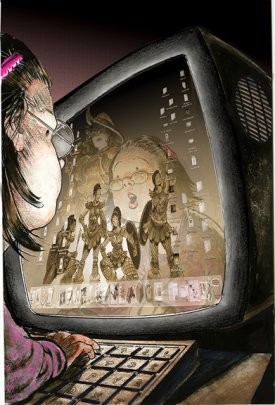
Cory Doctorow’s craphound.com ~ Sam Kieth cover for Anda’s Game comic

My favorite short story by Cory Doctorow, and one of my favorite short stories ever, is Anda’s Game. A comic book adaptation is planned, along with several other of his stories. Mine is on order already through Atlantis Fantasyworld in Santa Cruz, California!

As with Cory’s other works, it is available for free, online. There is also a fantastic reading of the work available through his podcast, and at the story’s official page, here.

Comments

Popular posts from this blog

Tony diTerlizzi and classic D&D monsters

The sixth entry of his series on drawings of classic D&D monsters is up. He's one of my favorite fantasy artists. His work tends toward the charming and cozy, rather than others' focus on machismo or melodrama.

sad fate

“Our legendary personalities are evergreen ‘brands’ with the benefit of worldwide recognition,” reads a message on the Richman agency’s website. Guardian UK Article *vomits* Where is the line drawn between “public figure” and “celebrity”? How can a dead person have an agent, particulary where there are no specific works concerned other than a sense of character? It’s one thing to insist that Duck Soup is a work that should be protected (which any more simply means controlled by whomever has the most buX0rs), but shouldn’t personalities and such pass into the public domain as well? ( boingboing : Bill Gates 0wns Einstein, Groucho , Freud, Asimov, Fuller, et al )

on sheeps and androids

The movie Blade Runner is very dear to my heart. It is a treatise on the nature of existence expanding on, and perhaps exceeding the reach of the Phillip K. Dick work which inspired it, Do Androids Dream of Electric Sheep? Perhaps I have missed out on some greater subtlety of PKD's work, but the point of DADoES pursues the definition of fake, while Blade Runner instead focuses on what is real. Where the replicants in the novel are sociopathic monsters who emulate emotions solely to gain traction against humans who may hunt them, the humans there rely on machines to dictate their own emotions for them. They dial for "energetic determination" or "six-hour self-accusatory depression." As much as the replicants are machines incapable of real emotion, humans are similarly reliant on a machine to simulate emotion for them. In contrast, the movie's central them is spelled out for us in Deckard's apartment, when Rachel is playing the piano. She professe...